
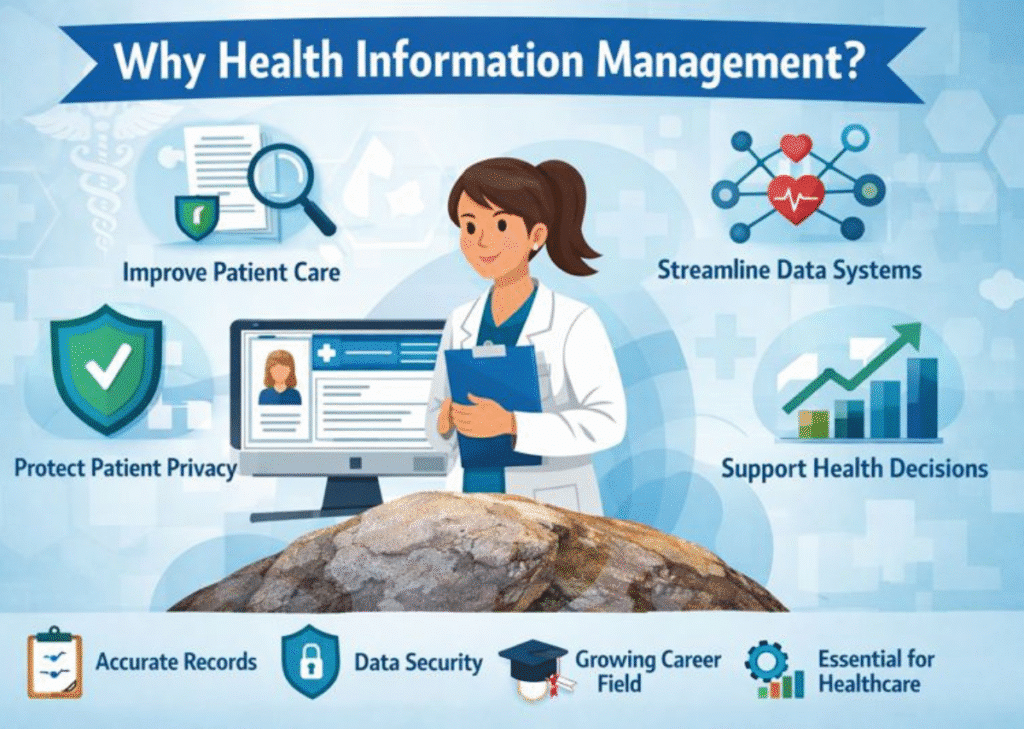
During an era of digital transformation, big data and patient centred care, the query of Why Health Information Management has never been more important. The paper explains why Health Information Management (HIM) is important in the modern world, its current development, and the issues organisations and professionals should pay attention to stay on top.

What Is Health Information Management (HIM)
Definition and Scope
The concept of Health Information Management (HIT) is defined as the process of collecting, organising, protecting, analysing and utilizing health related information or data- traditional (paper) and electronic. Baker College+3AHIMA+3The HIPAA Journal+3
HIM cuts across clinical data (records, treatments, diagnoses, etc.), administrative data (billing, schedule, etc.), compliance, privacy, data analytics, and information governance.
Why Now Is a Pivotal Moment
Health Information Management is becoming more central to a number of forces:
Such a thing as the mass implementation of electronic health records (EHRs) and digital tools. The HIPAA Journal+2The University of Scranton+2.
• Rising regulatory and privacy requirements (e.g., data protection of patients, danger of breaches). SDV INTERNATIONAL+1
• Increased data volume e.g. remote monitoring, telehealth and cross platform exchange.
• The transformation in the direction of value based care, analytics and population health management.
Why Health Information Management Matters
Improves Patient Care and Outcomes

Timely, correct and readily available health information can lead to improved clinical decision making, reduced unnecessary tests, coordination and eventually improved patient outcomes. One source states that HIM is a critical position, which is engaged in ensuring that data is transformed into improved patient outcomes. The University of Scranton
Increases Data Protection, Data Privacy and Compliance.
The probability of data breaches, unauthorised access and non compliance increases with the increase of digital health information being shared across systems. HIM professionals are critical towards the protection of sensitive records and the handling of regulatory requirements. SDV INTERNATIONAL+1
Motivates Business Economy and Cost Management.
Properly operated information systems decrease organizational overhead, optimize operating processes (such as care transitions, retrieval of records), minimize waste and aid in decision-making operations.
Allows Data Driven Decision Making and Innovation.
Health Information Management preconditions analytics, population health insights, predictive modelling and strategic planning. The organisations which have taken advantage of HIM are in a better position to be innovative. The University of Scranton
Plants Organisations with Future Change.
HIM is the key to change with its trends of cloud systems, mobile access, interoperability, and AI. Strong in HIM presupposes that the organisation is future ready.
Current Trends and Key Focus Areas in HIM
Digital Transformation & Interoperability
The impetus towards interoperability between systems and the shift to paperless systems is key. According to one of the articles, HIM entails gathering, safeguarding and examination of patient health details to guarantee its accessibility in the digital age. The HIPAA Journal
Data Governance and Quality
The data can only be useful when accurate, complete, and available and correctly coded. HIM focuses on the standards (ex: ICD, SNOMED), data capture workflows and governance models.
Privacy, Security & Cyber Risk
HIM should protect data integrity and access due to the increase in data breaches. Indicatively, one report identified millions of records that were left exposed through hacking/IT incidences. SDV INTERNATIONAL
Value Based Care and Analytics.
HIM assists in utilizing data not only in record storage, but also in enhancing care, lowering cost, tracking results and participating in strategic decision-making.
Workforce & Skills Evolution
With the development of HIM, another set of competencies is being required: informatics, analytics, regulatory insights, governance and strategic thinking.
How Can Organisations Build a Strong HIM Foundation?

Conduct an Information Audit
Begin with evaluation of the status quo: data collection, storage, access, codification, exchange and security. Identify gaps and risks.
Invest in Human Resource Investment.
Provide HIM professionals (and other teams) with the necessary skills: record handling, coding, IT basics, privacy/compliance, analytics.
Create Strong Information Governance.
Establish data quality policies, privacy policies, access policies, lifecycle policies, interoperability and standardisation policies.
Concentrate on Interoperability and System Integration.
Make sure that your information systems (EHRs, billing, analytics, HIE) communicate with each other, facilitate data interdepartments and settings, or to external partners.
Engage Stakeholders (Clinicians, Admin, IT)
Cross functional cooperation is the key to the success of HIM. Clinicians must have usable records; IT must develop secure, interoperable systems; managers must have analytics and cost control.Monitor Metrics & Continuous Improvement
Take important performance metrics (KPIs): coding rates, record coverage, record retrieval, access events, breaches of data, the use of analytics. Track and improve.
Frequently Asked Questions (FAQs)
Q1: What are some of the careers in Health Information Management?
A1: Health information manager, clinical data analyst, HIM coder/auditor, health informatics specialist, privacy officer, records manager, data governance lead are among the careers in the area of HIM. There is an increased demand with the digitization of health systems. NCCU Online+1
Q2: What is the difference between HIM and health informatics?
A2: HIM is more oriented in management of health data, records, coding, compliance and operation processes. Health informatics focuses on the utilisation of data, analytics, system development and insights. It overlaps and has different focus. Baker College+1
Q3: How do HIM professionals have the necessary skills?
A3: Data management, knowledge of coding standards (e.g. ICD 10), knowledge of health IT systems, knowledge of privacy and compliance, analytics, project management, communication with stakeholders.
Q4: What are the benefits of HIM to the patients?
A4: Higher quality care (because of more information), reduced errors, better coordination of care, access to their records, faster, better outcomes. The University of Scranton
Q5: What do you view as the largest challenges associated with HIM?
A5: Data security/cyber risk, interoperability barriers, data quality, resource constraints, change management risk, resource skills.
Conclusion:
Why Health Information Management then? Due to the growing digital, data driven healthcare market, HIM is the principal catalyst to efficient, effective, safe, and patient centred care. The organisations focusing on HIM are bound to gain – improved results, enhanced adherence, operational flexibility and innovation preparedness. HIM is involved in every level of modern healthcare, whether it is records management, analytics, or security, to interoperability.
And, in case you work in a healthcare organisation or even if you want to work in the field of HIM, it is high time to take action. Establish a platform today and you will not be catching up tomorrow.